
Doing More Than Digital Out-of-Home: An Interview with Andy McRae
STRATACACHE sits down with industry veteran Andy McRae to unpack the differences between in-store retail media and traditional Digital Out-of-Home (DOOH) advertising, and to explore how measurement, placement, and creative must change when ads move inside the store.
Andy McRae is the General Manager of Dot2Dot Communications, the respected digital-signage and out-of-home company that is now part of the STRATACACHE family. With weighty experience deploying and managing digital signage networks in a variety of environments—including airports, shopping malls, and retail stores—Dot2Dot is a trusted technology partner for some of North America’s largest brands.
Over more than 14 years, McRae has overseen the growth of the company and the evolution of the digital signage ecosystem, giving him a front-row view of the rise of digital in-store retail media and how its advanced capabilities differ from—and can work alongside—traditional Digital Out-of-Home advertising to create compelling marketing campaigns.
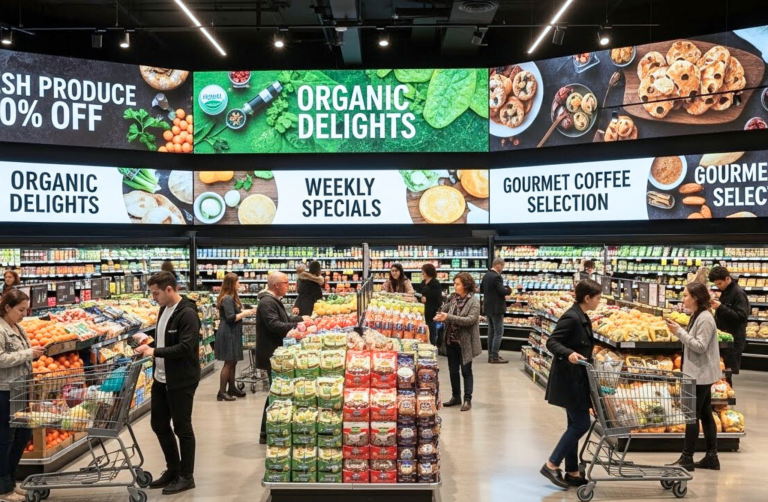
Now, as grocers and retailers around the world increasingly install digital screens in stores—turning entryways, retail aisles, and checkout areas into media-rich environments—our interview with McRae is particularly timely. His perspective helps retailers understand how to leverage these digital changes properly: not just by installing screens, but by building a retail media network that uses data, targeting, measurement, and strategic media deployment for maximum impact.
What do you see as the difference between in-store retail media and traditional Digital Out-of-Home?
Traditional Digital Out-of-Home (or out-of-home advertising) is mass media. It’s built for one-to-many reach: raising awareness, signalling an event, or influencing trips. Measurement for Digital Out-of-Home is typically an “opportunity to view” based on traffic passing the display. It can be targeted, but the metric is broad.
In-store retail media is different. It uses retailer data to target shoppers at the point of purchase decision. Pricing for deploying campaigns on these retail media screens should reflect sales conversions, not the traditional cost-per-thousand impressions (CPM) model used by Digital Out-of-Home. Where things get fuzzy is when retailers treat in-store screens as merely access to eyeballs and sell them like Digital Out-of-Home. Neither approach is inherently wrong—it’s a question of which model fits a retailer’s customer, footprint, and goals.
How does digital in-store retail media contribute to a retailer’s overall Retail Media Network?
In-store digital is the most important piece of a full Retail Media Network (RMN). It delivers hyper-targeted messages that reflect the signals most likely to change shopper behaviour—and drive conversions. Coupled with a robust measurement platform, you can trace a viewed message to a sale.
Another major advantage: in-store digital content can be updated quickly as conditions change. That agility is powerful. Still, in-store digital is only one component of an RMN. Static signage, web advertising, social media, and connected television (CTV) also play roles in a complete, omnichannel offering.
What common misunderstandings do retailers have about in-store retail media and Digital Out-of-Home?
Many retailers treat in-store media as just another Digital Out-of-Home product and attempt to sell it by CPM. That rarely captures its full value. The real distinction is data: in-store media can use loyalty programs, point-of-sale (POS) systems, and other first-party signals to personalise messages. That ability to personalise at the point of sale is what defines retail media’s unique value.
How do Digital Out-of-Home and in-store retail media impact the shopper experience?
Digital Out-of-Home is effective at creating awareness and pointing customers toward where to buy a product. In-store digital, by contrast, delivers targeted content about specific products at the moment the shopper is making a decision. In short: Digital Out-of-Home helps people discover; in-store retail media helps them decide.
What advice would you give retailers unsure about offering in-store digital versus a Digital Out-of-Home proposition?
Start with a deep review of your customer profile. If your customers segment cleanly, your product assortment is broad, you have good data inputs, and your footprint is strong, you’re a good candidate for a retail media network.
If your customer base is more generic but you have a large state or national footprint, Digital Out-of-Home may be a better fit. Even a single store can benefit from in-store digital; a 3–10% sales uplift can justify the investment.
If you move forward, build a full plan: implementation, ongoing management, measurement, and reporting. This is not “set it and forget it.”
Are there differences in campaign creative between in-store digital and Digital Out-of-Home?
Yes. Digital Out-of-Home creative must be short, clean, and immediate—people often have less than eight seconds to see it. Outdoor screens usually rely on still imagery rather than moving video. In-store creative has a longer window and can support richer storytelling, including video and more detailed product information.
What types of content perform particularly well in-store but not on Digital Out-of-Home—or vice versa?
Video and comparative content perform much better in-store. Digital Out-of-Home excels at quick, high-impact messages that drive awareness. In-store retail media is where shoppers want detail and comparison to help them buy.
Does screen placement strategy differ for in-store media compared with Digital Out-of-Home networks?
Absolutely. Digital Out-of-Home placement focuses on maximising traffic and reach. In-store placement is strategic: you must account for surroundings, traffic flow, and dwell time, as well as the likely mindset of the shopper in that particular part of the store. The right location in a store turns an impression into attention—and can directly influence purchase.
How do you see the future of in-store retail media evolving compared with Digital Out-of-Home?
They are complementary and will both grow. A full campaign needs three elements: awareness, location information, and point-of-purchase messaging. Out-of-home and Digital Out-of-Home deliver the first two; in-store retail media is unparalleled in delivering the third. Connected television and online channels complete the journey.
Stores aren’t disappearing. People value touch, feel, and real-world interaction. The job of the retailer is to offer the best of both worlds—and in-store digital is uniquely suited to do that.
Are there any innovations that excite you about the future of in-store digital retail media?
On the hardware side, Direct View LED is exciting—quality is improving while prices fall, and the display flexibility is impressive. On the software side, the integration of data into content creation and scheduling is transforming relevance, measurement, and reporting.
People talk about an artificial intelligence “north star” that builds ads on the fly for precise contexts. We’re not fully there yet—approvals and accuracy are real constraints—but artificial intelligence is already pivotal in Retail Media Network strategy and in accelerating content tools.
Bottom Line: In-Store Retail Media Is Not Digital Out-of-Home
Andy McRae’s perspective highlights a clear imperative: in-store retail media must be treated as a data-driven, measurable component of a retailer’s media mix. Digital Out-of-Home and in-store retail media play different roles in the shopper journey. When retailers match strategy to customer profile, instrument their stores, and invest in measurement, they unlock the true commercial value of retail media.
Let STRATACACHE help you map placement strategy, measurement requirements, and creative approaches to your customer profile—so you can decide which mix of in-store digital and Digital Out-of-Home will deliver the best commercial outcomes.