
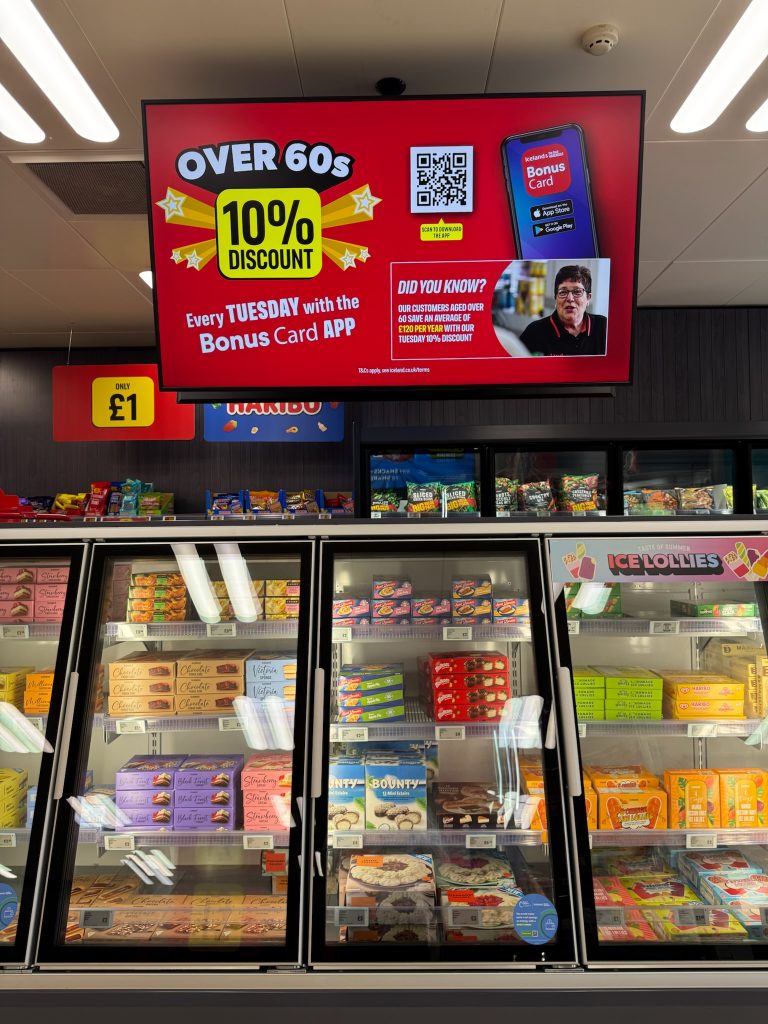
STRATACACHE: Why has Iceland decided to invest in an in-store retail media network at this moment?
Adam Smith: We’ve actually had a retail media function for about five years, but it’s had its ups and downs internally. What’s changed is momentum: We reset the team, secured leadership buy-in, and locked in the operational focus we needed. If we don’t step up now we risk falling behind, and right now the market is simply moving too fast to wait.
STRATACACHE: What are the key business objectives for Iceland and The Food Warehouse from this network?
Adam Smith: Our key objective is to complement Iceland’s identity and support category plans. We want to open doors with brands that have stopped spending in retail, enable more precise campaign targeting, and prove the value of in-store media with real, measurable results. If we can bring back lapsed brand spend and show meaningful uplifts, that becomes a self-reinforcing cycle.
Editor’s Note: You can read a detailed case study about the success that McCormick found with Iceland’s in-store network — the pilot showed a 17% uplift in category transaction share during the activation window.
STRATACACHE: Walk us through the planning and rollout. How did you decide which stores, placements and screen formats to use?
Adam Smith: We started pragmatically with transaction data. Stores were grouped and tiered by performance and format so brand investment is focused and not wasted. From there screen placement is a store-by-store decision — layouts vary hugely between high-street Iceland shops and the larger Food Warehouse sites. We set up a parameters checklist — entrance, windows, grocery aisles, dwell hot spots — and then review the blueprints against that checklist. It’s a balance: standardize where you can, adapt where you must.
To scale quickly we prioritized stores and formats that give clear measurement signals first, then iterated on placement and creative as we gathered real footfall and dwell data.
STRATACACHE: You’re working with our Walkbase team for in-store sensor technology. How does that integrate with the network?
Adam Smith: Walkbase is a cornerstone. Their sensors let us convert store activity into measurable media metrics — impressions, dwell, exposure — with far greater precision than older approaches. By fusing sensor data with transactions we can tell brands, with much more confidence, who actually saw their ad and whether that exposure was linked to purchase. Beyond measurement, Walkbase gives us footfall patterns, shopper flow and dwell insights that help with layout, staffing and promotion planning. That data moves the network from guesswork to true performance marketing.
STRATACACHE: How does in-store sensor data change campaign targeting and optimization for brands?
Adam Smith: It changes everything. You can schedule content around real footfall patterns and times of day, target specific store clusters or regions, and monitor engagement in near real time. Measurement is no longer just “did sales rise?” — it’s dwell time, conversions and exposure by store. That means campaigns can be optimized mid-flight: change creative where engagement is low, shift weight to better-performing stores, or tighten targeting to shoppers in specific zones of a store.
The result for our supplier brands is clearer ROI and more accountable media. They can see, and then act on, what works.
STRATACACHE: A lot of retailers struggle with screens becoming intrusive. How do you avoid that?
Adam Smith: Our approach is simple: The screens must add value. We aim to inspire shoppers — recipe ideas, meal solutions, helpful promos — not shout at them. Content must be timely and relevant to the location: a breakfast idea near morning traffic, meal inspiration near grocery aisles. Placement matters too — screens go where dwell time is natural, not where they interrupt flow. If a screen feels helpful, shoppers accept it; if it feels noisy, we’ll change it.
STRATACACHE: Why did Iceland choose STRATACACHE as a partner for the rollout?
Adam Smith: STRATACACHE brought the right mix of agility and technical depth. From day one the relationship felt collaborative — practical conversations, clear expectations and a willingness to flex to our needs. They also have the team experience to execute in complex store environments, and that gave us confidence the rollout could be done fast but carefully.
STRATACACHE: On the operations side — how did you keep disruption to a minimum during installation?
Adam Smith: It wasn’t easy. In many cases installation happened overnight or during short closures. Communication with store teams was critical — and we learned that what looks simple on a plan can become complicated on site. The teams had to be ready for things to go wrong and react quickly when they did. That practical readiness and the willingness of local teams to help make rollouts survivable.
STRATACACHE: As the network matures, what new capabilities are you expecting to unlock?
Adam Smith: We’re excited about advanced audience segmentation using live behavioral and transactional data, dynamic creative that adapts by store performance, and predictive analytics to plan campaigns more accurately. Closed-loop attribution that directly links exposure to sales across categories is the real prize. We’re also exploring tighter loyalty integration so messaging can feel personalized while still respecting privacy laws.
STRATACACHE: How do you make it easy for brands to buy into the network?
Adam Smith: One of our team’s core principles is “Easy to buy – detail on demand.” We need to keep the onboarding simple, making it more attractive with clear packages, flexible buying options, collaborative planning sessions. Then to complement the ease of purchase, we need the data to be equally useable and easy to access through real-time dashboards, so brands can see impressions, dwell and sales uplift. We’re focused on a test-and-learn approach: small pilots that scale when they prove ROI. That transparency and speed helps brands take the leap.